

Tuesday, September 2, 2014

Saturday, August 30, 2014
Day +92 IVIG & Appetite Changes

Ryan ended up requiring IVIG yesterday (see previous post
for an explanation of what IVIG is). I anticipated that it would take anywhere
from 2 to 4 hours, but it was more like 6 hours from the time we got to the
infusion suite. However, everything went
fine and he didn’t have any reactions (some kids get the chills and shakes – or
other reactions.)
This coming week is Ryan’s last week on steroids. As he
tapers off, I have noticed that the last few days he doesn’t have an appetite
in the morning and it borderlines on nausea. I have to persuade him to eat something small
so that his morning medications do not upset his stomach. Even then, he only wants to eat a few
bites. Then, he makes up for it at lunch
and dinner (he had two servings of spaghetti for lunch today and then was a
little sad that we were out and he couldn’t have more). I am concerned that the appetite change could
be a sign of gut GVHD flaring up now that he is coming off the steroids. I am really hoping that is not the case.
We have an exciting event coming up on Tuesday… Ryan is
scheduled to have his central line removed! It will be so nice for him to be free of tubes
dangling from his chest. He will be able to take a normal bath or shower again
without worrying about his lines and dressing getting wet. It will also be the first time in 14 months
that he will not have a medical device surgically implanted in his body.
The picture included in this post is one of my favorite post-transplant
images of Ryan celebrating his freedom from the hospital. Brad captured it on
the shore of Puget Sound
Tuesday, August 26, 2014
Day +88 Anxious to Go Home & Sad for one of our fellow Aplastic Anemia families


We are so ready to go home…
Ryan and I are both really homesick.
Ryan has been missing his kitty, Dexter (and of course his dad and
sister). Yes, we named our cat after the
TV serial killer, but it seemed fitting being that our cat is also a “red head”
(flame point Siamese).
The week before last, we practically begged Ryan’s team to
give us a pass to drive home for just a couple of hours. I got a little bit of
a speech about how it is against their policy, and that some doctors will not
even consider it, but they didn’t give me too hard of a time. They decided to
let us go because Ryan has been meeting his goal for fluid intake and no longer
needs to be on IV hydration. However,
the doctor said, “Well, if you’re going to drive all that way, you might as
well stay the night.” I wasn’t going to
argue with that!
We had to set up an emergency plan, and I had to agree that
if Ryan even had a hint of a fever or anything else concerning, I would rush
him right back to Seattle
(or call 911). Neither of us had slept
in our own beds since May 21st.
Select Comfort donated Sleep Number beds to the Ronald McDonald House
Apartments (which is really nice of them), but after all of this time, I still
can’t seem to find my “Sleep Number.” It
was heaven to sleep in my own bed!
Now that we have had a taste of home, these last few weeks
in Seattle seem
to be dragging along in slow motion.
Ryan’s “Day 80 Work-up” started last week and continues into this
week. This is a repeat of all the tests
and exams that were done leading up to transplant, with some new tests
added. The purpose of the work-up is to review
the status of his bone marrow, determine if he has damage to his body from the
transplant, and to decide if he is on track to be discharged at Day +100. So far, he is on track!
Ryan is so sheltered right now and is really missing the social
interaction he normally would have at school with his friends. The last few weeks during our clinic visits,
I can see that he is just starving for interaction with people. “Stranger Danger” has gone out the window and
he has become “Chatty Cathy” with anyone who will give him the time of day. He asks people where they are from, why they
are there, whether they are a transplant patient, whether they have a Hickman
line like his, and so on.
We don’t see many other kids at SCCA and the adult patients
seem to get some comic relief from his 5-year old boy antics. He has a few “regulars” that he visits with
in the waiting rooms. In fact, last
week, he was asking one of his lady friends if she had a Hickman line like
his. Before she could answer, he quickly
pulled her shirt collar out and took it upon himself to look down her shirt. As
I was cringing and trying to explain to him that it wasn’t appropriate, the
woman just laughed and said “oh, that’s okay.”
Most transplant patients have had their privacy violated so much that I
think it probably really didn’t bother her. But still…
He has also somehow worked a deal with the woman in the
cafeteria. By the time I pay for my coffee and turn around to usher him along,
a full cup of whipped cream with a spoon has somehow magically appeared in his
hands.
All of Ryan’s appointments lately seem to be taking twice as
long because he has questions about EVERYTHING.
He wants to know what every button on each machine does and how
everything works. At least twice a week someone
comments “Oh, you have a little engineer here.”
We have some of the test results from the Day 80 Work-up
back and, so far, they are very encouraging.
Here is a summary:
Ryan’s platelet count has been over 200,000 for about 3
weeks now. His red and white counts are fluctuating, but in a decent range.
His DEXA bone density scan was normal for his age (good
news, because high dose steroids can do some damage.)
He had a second peripheral blood chimerism test to determine
what percentage of his cells are donor cells versus his own cells. The test confirmed that all three cell lines
are 100% donor (no trace of his old “bad” cells).
In addition, he had a bone marrow biopsy and aspirate last
week. A chimerism done by biopsy is more
accurate than using peripheral blood.
The biopsy was also 100% donor.
The cellularity of his marrow from the biopsy was reported
as 30%-40% with no dysplaysia (cells of abnormal shape or size). The cellularity percentage concerned me at
first, because I was expecting around 70-80%.
However, the team stated that a cellularity in this range is acceptable
for only being 80 days post transplant.
Many patients at this stage are only around 10-20%.
Ryan continues to test negative for CMV, Epstein Bar (EBV),
and Adenovirus. These are the three main viruses that lay dormant in a majority
of the population and can re-activate in a transplant patient, causing significant
problems.
A skin biopsy was done to test for GVHD. The report stated that his skin sample was
relatively normal with “a few apoptotic cells”.
Translation = there is only a trace of GVHD currently; nothing major.
His kidneys are stable and his liver is doing well (common
problem areas for transplant patients).
Ryan will likely need an IVIG (Intravenous Immunoglobulin)
transfusion within the next week because his IGG (Immunoglobulin G) level is
low. IVIG contains antibodies collected from the plasma of healthy blood donors
and will replace the antibodies that his body is not currently making. This is
extremely common in transplant patients who are immune suppressed, and there is
a chance that he will need some repeat transfusions until his immune system
gets stronger. It is interesting to note
that a single dose of IVIG contains pooled immunoglobulin from the plasma of
1,000 to 15,000 donors. Thank you once again blood product donors!!!
I was very sadly reminded this afternoon of how lucky we are
to have Ryan regaining his health. I learned that another young Aplastic Anemia
fighter, Sydney Elizabeth, passed away today
(https://www.facebook.com/fightwithsydneyelizabeth). My thoughts are with her family tonight as
they cope with her passing.
Day +70 Full of Energy!
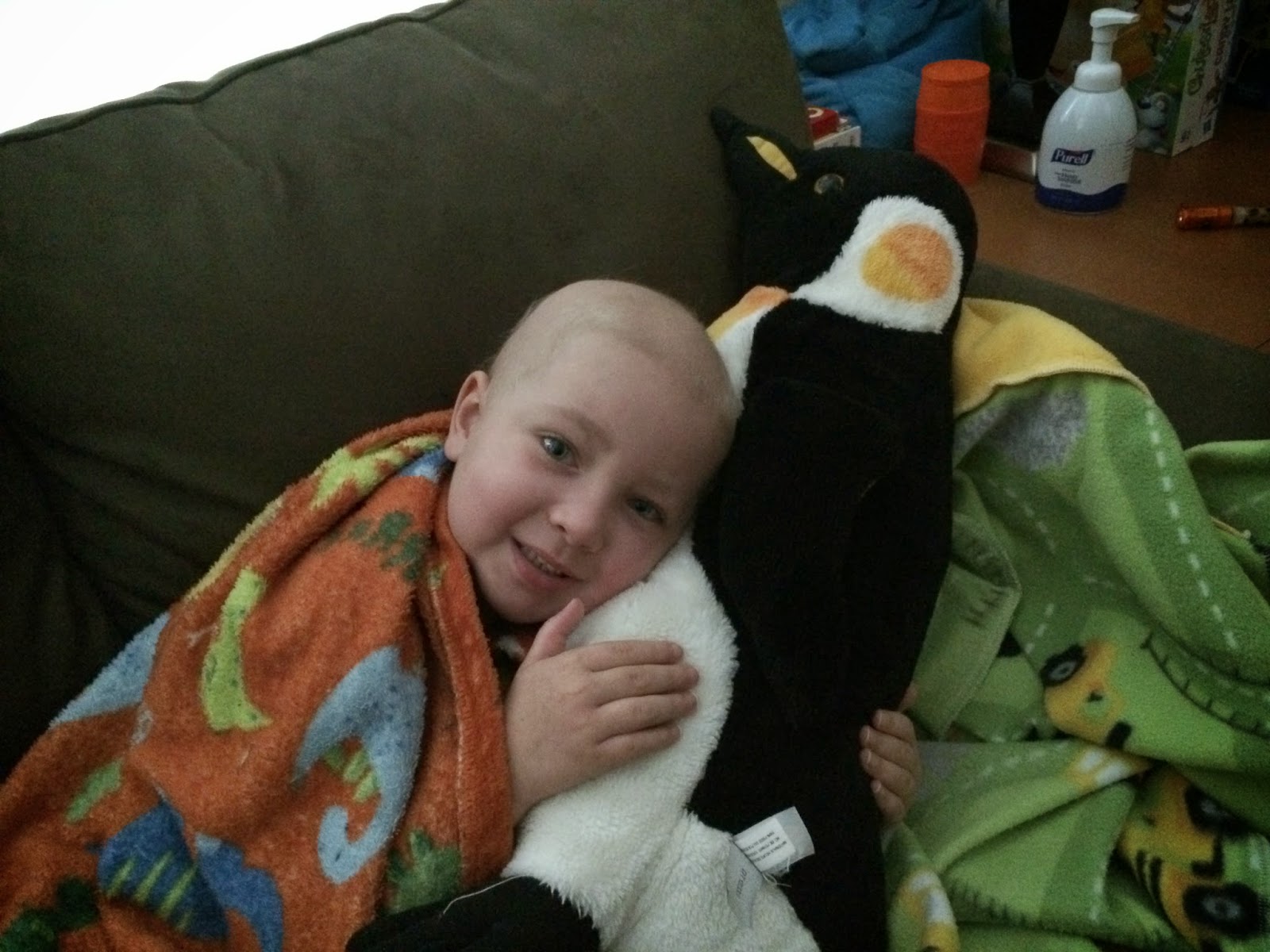
While driving in the car a few days ago, Ryan announced from
the back seat "Mom, I feel like I am back to my old self. I feel really
good." Then, this morning I asked "How are you feeling this
morning?" His response: "PLAYFUL!"
Wednesday, August 6, 2014
Day +68 Doing Well


It’s amazing to think that Ryan’s last transfusion of blood
products was over two months ago. This
time last year, there were days where he needed multiple transfusions in a
single day. Not only are his counts holding steady, they have gone up in the
last couple of weeks! His current counts
are:
Platelets: 197,000 (Getting close to “normal”)
Hematocrit: 35 (Normal )
Neutrophil Count: 2830 (Normal )
The GVHD of his skin is still an issue at times, but it is
much improved. The PUVA therapy really seems
to be helping. As a result of the
improvement, we have been able to continue weaning his steroid dosage down
significantly. If the current trend
continues, he will be off steroids in about a month. This is good for several reasons. Steroids affect personality, appetite, add
additional suppression to his immune system and cause bone loss. Ryan’s last chest x-ray shows that he does
have some bone de-calcification due to the steroids. However, it is minor enough that it can be
reversed by discontinuing the steroids and getting enough calcium and vitamin
D.
Last night I had the news on and there was a story about a Florida clinic owner and
his colleagues being arrested in a doping scandal for supplying steroids to
both professional baseball players and high school athletes. The reporter made a comment about the players
being in trouble for taking steroids.
Ryan stopped in his tracks, looked a little alarmed, and then asked
“Mom, am I in trouble?” It was really
funny, and it did spark our first conversation about how you should only take
drugs prescribed by your doctor (and that are needed for health conditions),
not drugs that are given to you by other people or taken for reasons other than
being sick.
At Day +80 SCCA starts a pre-discharge work-up. We are excited to be starting the work-up
week after next. Ryan will basically go through all of the same tests and
appointments that he did right before transplant, and then some. This will include a bone marrow biopsy and
chimerism test to look in detail at his marrow for any abnormalities, and to
determine if he is still 100% donor cells.
They will also check his IGG level (the level of certain antibodies in
the blood, made by the immune system to fight antigens such as bacteria,
viruses, and toxins). He will have a skin biopsy to check the status of his
GVHD, chest imaging (CT and/or X-ray), bone density scan, an oral medicine
exam, and potentially a visit to the kidney doctor.
Then, as we approach Day +100, we will make a decision regarding
whether his central line should be removed.
That is normally a big event for kids because it means that they can
take a normal bath or shower in more than a couple inches of water, and without
having to have their chest covered in plastic.
Some transplant patients are also given permission to swim at that point
(although probably only if they have a pool at home where they can control the
cleanliness and who enters the water.) I
think Ryan will be really happy if he gets a few late summer days in September
to splash around in his kiddie pool once we get home.
In the meantime, we are spending most of our time avoiding
the public, as much as possible, and trying to follow all of the strict
post-transplant rules. There are rules
such as: he cannot sit on the grass, dig in the dirt, go hiking in dense
foliage, be near fresh flowers or live plants, or eat nuts that are roasted in
the shell (among other food restrictions). It is difficult at times to remember
all of the rules and I feel like I am constantly telling him he can’t do
something or can’t have something.
However, in some aspects, SCCA is not as strict as some
other transplant centers. For example,
Ryan can have fresh fruits and vegetables at home, as long as I select them and
wash them well. He is also not required
to wear a mask in public or outdoors (although at times I make him wear one
anyway, and I will be especially strict about it as we enter the cold/flu
season this winter). Instead of a mask,
SCCA just asks that we avoid going to places where he may have close contact
with people. Restaurants are okay, but
there are dietary restrictions and we have to go at non-peak times when there
will not be very many people. We play it a little safer and I am very selective
about where I will take him, period. I try to limit his exposure to the public
as much as possible, while still letting him have some time as a kid that feels
mostly normal to him.
Last weekend was Seattle Seafair and the Navy Blue Angels
were in town. Ryan got to meet a couple
of them at SCCA. That made him want to
go watch them fly. Their show is always
my favorite part of Seafair, so we set out to find a place where we could watch
them, but not be too close to other people. We ended up driving around Seattle and catching
glimpses of them overhead. Then, we went
to the Spaghetti Factory, which was Ryan’s first time dining in a restaurant
post-transplant. Ryan really enjoyed dining there. We had a window seat right next to the train
tracks, so he was able to watch them go by.
Plus the Blue Angels kept buzzing by.
I was really paranoid about germs and kept having to tell
him not to touch the wall, the window blinds, etc. Then, he ordered a “Cotton Candy
LimeAid”. I snapped a few pictures
because it cleverly came with a big puff of cotton candy on the straw. Ryan loved it. Then, after he had already had a few sips, I
noticed there were wedges of fresh lime mixed in with the ice! I had to send it
back and ask that they make it without any fresh fruit. That incident was followed by me having to
take pistachio’s away from him today because it dawned on me that he can’t have
nuts that are roasted in the shells. So
many rules - but all to try and keep him safe and healthy.
Tuesday, July 22, 2014
Day +53 A Day in the Life of a Transplant Patient & Small Victories


Ryan’s platelet count has rebounded a little bit. They
jumped up from 78K to 119K in just four days.
I felt so relieved when I found out.
I know that platelets will fluctuate and that he is doing fairly well,
but anytime I see his platelets go down, I panic. I just can’t help it. I watched his counts go down over and over
for almost a year and it was always bad news.
I am now conditioned to be disappointed to see numbers go down and it
will take me awhile to get over that.
I went into yesterday’s appointment with my usual list of
questions and concerns. After not seeing
an increase in platelets for a few weeks, I wanted to know if Ryan had been
tested yet for platelet antibodies and, if not, I was going to request it. If someone has platelet antibodies, it means
that their immune system is mistakenly creating antibodies that attack and kill
platelets. So, my question “Has Ryan
been tested for platelet antibodies?” was met with “Well his platelets are
almost 120K, that’s pretty good.” The
team acknowledged once again that they know I am worried, but they want me to
know that they are not worried.
Another piece of good news is that Ryan hasn’t needed any anti-itch
meds in over 24 hours. He still has a slightly visible GVHD rash and, since we
lowered his steroid dose again Sunday, his cheeks are a little pinker. However,
so far he hasn’t had a major GVHD flare up. The PUVA therapy seems to be
helping some. Being off the anti-itch meds (which also act as sedatives) has
certainly increased his energy level and overall happiness. He has been a lot
more loving the last couple days and has been downright silly at times.
On a non-medical note, Ryan’s latest hobby is mopping. Yep, you read that right. He has been asking
every day this week if he can mop the floor.
I figure he can’t do much damage with a Swiffer, so why not? It also
gives him some additional exercise so it’s a win-win. I am secretly hoping he will want to continue
mopping everyday when we return home.
In case you are wondering what Ryan’s days are like, below
is a sample of a typical clinic day (This was yesterday, Monday 7/21/2014):
6:30
I wake up and jump in the shower
6:45
Wake up Ryan and disconnect the IV used for overnight fluids
7:15 AM
Leave for Clinic
7:45 AM
Arrive at SCCA Clinic
8:00 AM
Blood Draw at Lab
8:30 AM
Take morning medications & grab quick breakfast in the SCCA
cafeteria
8:45 AM
Hickman Line Dressing Change (Ryan’s most dreaded
appointment every week – it hurts…)
9:30 AM
Appointment with Nutritionist:
Weight/height recorded. Nutritionist advises that Ryan needs
to continue working on getting more fluids, eating more potassium rich foods
and adding calcium as much as possible.
We hear for the first time that Ryan’s last chest x-ray showed some bone
de-calcification, therefore, calcium and vitamin D are really important right
now.
9:45
Take Psoralen in preparation for 11:15 PUVA treatment (must
be taken precisely 1.5 hours before treatment to be effective)
10:00
Clinic Appointment with Transplant Team
Vitals are taken and we discuss medications, fluids, skin
symptoms, lab results, ekg results, hickman line function, appetite, nausea,
and so on. The de-calcification shown on the last chest x-ray is brought up
again. The team re-assures us that it is reversible, but we need to continue to
address it. Note: Ryan already takes two
Viactive calcium chews a day, along with Vitamin D. The bone issue is a common side effect of
transplant and the high-dose steroids – all the more reason to keep tapering
him off the steroids, if possible.
11:00
Mid-day Medications
11:15
PUVA Therapy (a.k.a. “The Tanning Bed”)
12:00 PM
Lunch back at the RMH apartment. Ryan sneaks in some
SpongeBob on TV while I work on Laundry.
2:00 PM
Physical Therapy at Seattle Children’s
3:30 PM
Return to the SCCA clinic to pick up new prescriptions and
IV fluid bags to be used until the next clinic appointment on Thursday.
4:30 PM
Return to RMH apartment
5:30
Dinner
7:30 PM
Start prepping IV pump (gather supplies, check pump battery,
program pump, attach tubing to bag and prime)
7:45 PM
Clean and flush Ryan’s Hickman line and hook up IV.
8:00 PM
Evening Medications
8:30-9:00 PM
Ryan goes to bed (by this time, Ryan is normally asking if
he can go to sleep…)
10:00-11:30
Around this time, I generally go to bed, but I am so busy
processing everything that I have a hard time going to sleep. About the time I finally drift off, I hear
Ryan wake up and yell from the other bedroom “Mom! I have to go pee!” My job is to get up with him and hold the
backpack that contains his bag of fluids and IV pump so that he can do his
business…
Note: This week’s schedule is an improvement over last week
when Ryan needed anti-itch medication around the clock, including at 11:00 PM,
2:00 AM and 5:00 AM.
Saturday, July 19, 2014
Day +50 Half Way to the First Major Milestone


There is nothing magical about Day +100 other than,
statistically, transplant patients have better survival rates if they make it
to day 100. It is also the time when, if
Ryan is doing well, he can get his Hickman Line removed and, most importantly,
we can go home. It feels good to be half way there.
Overall, Ryan is doing well for where he is in the process.
Below are updates on a few random topics:
Labs:
Platelets dropped a few weeks ago from a high of 155K, but
have leveled out around 78K. The team is not concerned about it. They often see platelets decrease when a
patient has GVHD. Ryan is also on some medications that can artificially lower
counts. Once he is further along and off
some of the medications, his counts should start increasing again.
ANC has been in the normal range (around 4,500 most days).
Hematocrit has been steady in the 33-35 range. The team told me at his last appointment that
they had expected his hematocrit to drop because they have been taking so much
blood for lab tests and research, that no person would be able to produce
enough new blood to keep up. Again, this
is temporary and it is not hurting anything.
I have agreed to the additional research blood draws because Ryan had a
very rare diagnosis and I think it is important to allow experts in the field
the opportunity to learn from him. Maybe
they will find something in their research that will help another child in the
future. It is the least we can do to pay
Ryan’s gift forward.
GVHD:
Ryan is still fighting some skin GVHD. He has been on high
dose steroids now for about 35 days. At
the highest doses, he had quite a few side effects, so the team slowly began
tapering him off of them. However, once
the dosage was lowered to a certain point, his skin rash and itching flared
back up. I was sure the team would bump
the steroid dosage back up. However, to
my relief, they offered to try an alternate therapy called “PUVA” (psoralen +
UVA treatment).
PUVA is a therapy done three times a week for several
weeks. It involves taking psoralen, a
drug that makes the T cells that are attacking the skin sensitive to UVA light,
an hour and a half before treatment and then laying in a tanning bed with
special bulbs for a few minutes. The UVA light then “zaps” and knocks down the
offending T cells.
It was really difficult to convince Ryan to get into the
tanning bed. I am sure it looks really
scary to a 5-year old. Plus, he knew it
would get warm and his skin was already itchy and bothering him, so he was
afraid the hot bed would make it worse. It took some real convincing, and
thankfully the nurse that administers the treatment is really patient and good
with kids, but Ryan finally let me lift him in and he stayed still the entire time. He had his second treatment Wednesday and now
he says it’s fun and he likes it. I am
also seeing some slight improvement in his skin already.
Chimerism:
A Chimera was a creature in Greek mythology usually
represented as a composite of a lion, goat, and serpent. Contemporary use of the term “Chimerism” in
bone marrow/stem cell transplant derives from this idea of a “mixed” entity,
referring to someone who has received a transplant of genetically different tissue.
At Day +28, a chimerism test is performed to analyze the
bone marrow recipient’s DNA to determine what percentage is the donor’s DNA and
how much of the recipient’s DNA remains, if any. It’s not too uncommon at this stage for
transplant patients to be 95-98% donor and still have some of their own
DNA. In fact, some people never achieve
full chimerism, which can create a risk for future graft failure if the
original cells start to multiply and take over again.
I realized the other day that I hadn’t received Ryan’s
results yet, so I asked and was thrilled to hear “oh, he is 100% donor.” Woo hoo! It’s one less thing to worry about
right now.
Subscribe to:
Posts (Atom)